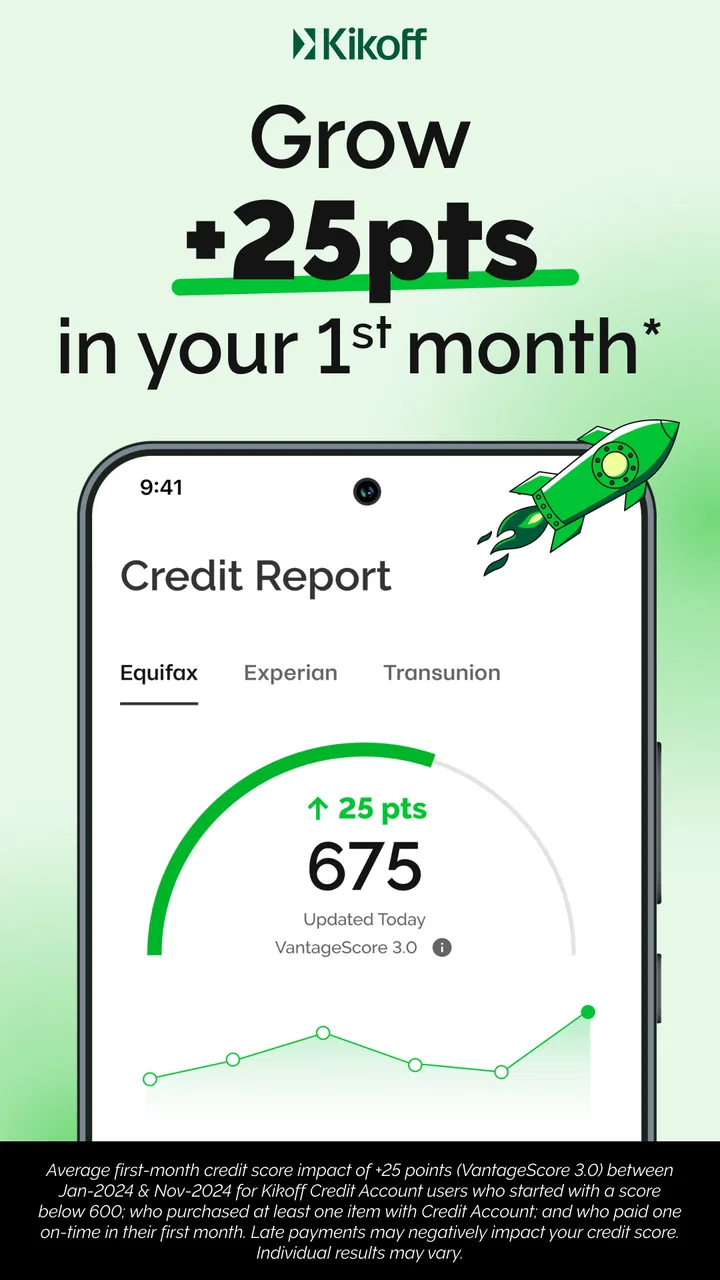
Kikoff - Build Credit Quickly
- 4.8
- Rating
- 5.00M
- Installs
- Free
- Price

 Analysis by App-foxy
When I look at a finance app, I do not start with its rating or download count. I start with a simpler question: what problem is it meant to solve, and does its way of solving that problem fit my situation? Kikoff - Build Credit Quickly is aimed at people who want to begin building credit without a traditional credit check. That makes it different from a general budgeting app, a bank account, or a conventional credit card.
My first impression is that Kikoff is most useful when I treat it as a focused credit-building tool rather than a complete personal-finance system. The app comes from Kikoff Inc., is free to install, and is rated for Everyone. Its central appeal is straightforward: it offers a route into credit-building for someone who may not want, or may not be ready, to apply for a standard credit product.
That narrow purpose is also the key to deciding whether it belongs on your phone. If you need help tracking spending, comparing bank accounts, paying bills, or planning investments, this is not the kind of app I would choose first. If your main obstacle is getting started with credit and you want an app built around that single goal, it deserves a closer look.
You May Also Like

 Blood Strike: 2.5 Anniversary
Blood Strike’s Loadouts Turn Every Drop Into a Tactical Gamble
A close look at Blood Strike’s custom loadouts: how fast access to signature weapons reshapes its battle royale rhythm, rewards preparation, and narrows the gap between fights.

 Pandora - Music & Podcasts
Pandora’s Music Is Easy to Start, but Harder to Recover
Pandora’s strength is its low-effort path from a seed to a station. Its weak spot is how much confidence it asks you to place in connection, setup, and quiet recovery.

 8 Ball Pool
 Is Built on Rivalries, Rematches, and Routine
A close look at the rivalries, rematches, shared routines, and unanswered safety questions that turn a quick pool match into a persistent mobile community.

 Samsung Music
’s Quiet Strength Is Playing What You Already Own
Its reach comes less from spectacle than from dependable access to a personal library. That simplicity is both the app’s strongest retention engine and its ceiling.

 AccuWeather: Weather Radar
AccuWeather Review: A Quick, Clear Forecast for Everyday Decisions
For everyday plans, the best forecast is the one you can understand quickly. AccuWeather makes rain timing, radar, and local conditions easy to act on, with a few trade-offs.

 Hill Climb Racing
Why Hill Climb Racing Still Turns Crashes Into One More Run
A tiny car, a bumpy hill and one more upgrade: Hill Climb Racing keeps resurfacing because its simple chaos makes every near-miss feel personal.
More From Our News Desk



How I Decide Whether Kikoff Is the Right Credit Tool
I use a few practical questions to decide whether Kikoff deserves a place in my financial routine: does it address a real gap in my credit history, can I keep up with its responsibilities, and does it add something my current approach lacks? Thinking through those questions helps me separate an easy first step from a lasting fit. From there, I look at what could make the app worthwhile beyond the initial appeal.
The first question is your starting point
The most important detail for a new user is the promise that no credit check is needed. That can make the initial decision feel less intimidating than applying for a conventional card or loan. It is especially relevant to someone with little or no credit history, or to a person who is cautious about submitting applications that may involve a credit inquiry.
Still, I would not interpret that as a guarantee of approval, a guaranteed score increase, or instant access to better borrowing options. Credit-building is a process, not a switch. The value of an app like this depends on using it consistently, understanding its terms, and giving the relevant credit activity time to matter.
I would also ask what I want to do after building credit. If my plan is eventually to qualify for a car loan, rent an apartment, or apply for a mainstream credit card, Kikoff may serve as an entry point. If I already have several active accounts and a well-established credit record, its focused approach may offer less value than a tool that helps me manage debt, utilization, and cash flow together.
What I would check before signing up
Even with a free app, I would read every screen during registration and review the account terms carefully. “Free” describes the app’s price, but any financial product connected to an app should be understood on its own terms. I would look for information about what service I am receiving, how payments work, what activity may be reported, and whether there are optional products or charges presented during setup.
This is not a reason to avoid Kikoff. It is simply good practice. Credit products can affect real financial decisions, and a quick onboarding flow should not replace reading the details. I would also make sure the personal information I enter is accurate, because mismatched identity details can create unnecessary friction when a service is trying to connect activity with a credit profile.
Why the audience size matters, but not too much
Kikoff has an average rating of 4.8 from around 115 thousand ratings, with roughly 15 thousand written reviews, and it has passed one million installs. Those numbers tell me that the app has attracted substantial attention and that many users have found the experience worth rating positively.
They do not tell me whether it will solve my particular problem. Finance apps often receive praise from people who had a smooth setup, while users with unusual credit histories or more complicated goals may have a very different experience. I would use the strong reception as a reason to investigate, not as a substitute for checking the product’s fit.
The everyday scenario where it makes sense
Imagine someone who has always paid for purchases with cash or a debit card. They now want to start building a credit history before moving into a new apartment, but they are uncomfortable applying for a regular credit card. They also do not want a product that encourages them to spend more than they can repay.
For that person, Kikoff can be appealing because the app keeps attention on the credit-building objective and removes the credit-check hurdle from the initial pitch. The sensible workflow would be to install it, understand the terms, complete the identity and account setup carefully, and then treat any required payment or account activity as a recurring financial obligation. I would put reminders on my calendar and keep enough money available so the process never competes with rent, utilities, or groceries.
The important insight is that convenience can create a new risk: a simple app may make a financial commitment feel less serious than it is. I would use the app precisely because I want structure, not because I want to stop paying attention.
Where Kikoff stands out
The clearest advantage is its accessibility. A traditional credit card application can feel like a poor fit for someone with no credit history or concerns about a credit check. Kikoff presents itself as a more approachable starting point, which can lower the psychological barrier to taking the first step.
I also like the fact that the product has a defined job. Many finance apps try to cover budgets, banking, investing, loans, rewards, and credit monitoring all at once. Kikoff is easier to understand when I view it as a credit-building companion. That focus can be helpful for a user who does not need a large dashboard full of unrelated financial tools.
Another practical strength is that the mobile format can make the process easier to revisit. I can check the app instead of keeping a paper folder or trying to remember which credit-building action I started. That does not make the underlying responsibility disappear, but it can improve follow-through for someone who responds well to reminders and a dedicated workflow.
A useful strategy: keep the app in its own lane
One non-obvious way I would use Kikoff is alongside, rather than instead of, a basic money-management routine. I would use a separate budget to decide what I can safely commit each month, then use Kikoff only for the credit-building task. This separation prevents me from mistaking a credit tool for a spending plan.
I would also avoid opening several new financial products at the same time just because I am motivated to improve my credit. Starting with one manageable account makes it easier to see what I am responsible for and what changes in my credit profile may relate to that account. Adding products too quickly can make payments and terms harder to track.
A second useful habit is to review the account after the first billing or reporting cycle rather than assuming that installation alone accomplishes anything. I would check that I understand the activity shown in the app and keep records of payments. If something looks different from what I expected, I would contact support before making assumptions about my credit profile.
The trade-offs I would take seriously
Kikoff’s focused design may feel limited if I want a complete view of my finances. It is not the app I would rely on for household budgeting, detailed expense categories, investment research, or a broad comparison of financial products. A dedicated budgeting app or my bank’s own tools may be better for those jobs.
The no-credit-check angle is attractive, but it can also lead users to expect immediate results. Building a meaningful credit history takes regular behavior and patience. I would not download Kikoff expecting a sudden transformation, and I would not take on other debt simply because I want to accelerate progress.
There is also a difference between building credit and having access to flexible borrowing. Someone who needs a card for travel emergencies, wants purchase rewards, or plans to carry a balance may need to evaluate conventional credit products separately. Kikoff’s suitability depends on the goal; a product designed to establish credit is not automatically the best product for everyday spending.
How it compares with the usual alternatives
The closest alternative category is a secured credit card. A secured card may suit someone who can place a deposit, wants a conventional card for purchases, and is comfortable managing utilization and full monthly repayment. Kikoff may be more comfortable for a person who wants to avoid a traditional credit-check process and does not need a standard spending card.
A regular unsecured credit card can be more versatile once someone qualifies. It may combine credit-building with everyday payments and other card features. However, it can also make overspending easier, especially for a new borrower who has not yet developed strong repayment habits. I would choose that route only when I can confidently pay the statement balance and understand the account terms.
Credit-builder loans are another category. They can provide a structured repayment path, but they are still loans, and their setup may feel more formal than an app-based starting point. Kikoff is more appealing when simplicity and accessibility matter most. A credit union or community bank may be better for someone who wants personal guidance and a broader relationship with a financial institution.
Finally, a credit-monitoring app can help me observe scores, reports, and alerts, but monitoring alone does not build credit. I see monitoring as a useful companion to a credit-building product, not a replacement for one. If my main concern is detecting identity theft or understanding report changes, a monitoring-focused service may be the better first download.
Questions I would answer before continuing
One question is whether the app is suitable for someone who already has credit. My answer is: sometimes, but not automatically. If my credit file is thin and I want another carefully managed step, Kikoff could still be relevant. If I already have several accounts, a long history, or existing debt, I would first review my overall strategy rather than adding another account by default.
Another question is whether the app replaces a budget. It does not, in my view. I would still use a spreadsheet, banking tool, or budgeting app to plan income and expenses. Kikoff should fit inside that plan, with its payment or account responsibilities treated like any other recurring obligation.
Users also reasonably wonder whether a positive app experience guarantees a positive credit outcome. It does not. The result depends on the account’s terms, reporting behavior, payment consistency, and the rest of a person’s credit file. I would judge success by responsible progress and a clearer credit history, not by expecting a particular score on a particular day.
There is also the practical question of what happens if I stop using it. Before joining, I would understand how cancellation, remaining obligations, and account closure work. I would not simply delete the app and assume that deleting an icon ends a financial relationship. Keeping screenshots or statements and confirming the status through the proper process is a small step that can prevent confusion later.
The cost of switching from another approach
Switching to Kikoff is easiest when I am starting from zero and have no complicated credit-building routine to unwind. In that case, the main cost is learning the app’s process and adding one new payment habit. I would set a reminder immediately and keep the account details in my usual financial records.
Switching is less attractive if I already use a secured card, a credit-builder loan, or a well-organized credit plan. I would not close an existing account simply to try something new without considering how that change could affect my history and available credit. I would compare the responsibilities, not just the app interfaces, and avoid overlapping commitments that strain my budget.
The best transition method is gradual. I would read Kikoff’s terms, confirm what I am agreeing to, and use it for a defined purpose. If it duplicates a product I already have, I would ask whether the added simplicity is worth another account to monitor. In personal finance, reducing unnecessary complexity is often more valuable than collecting more tools.
Who should skip it
I would skip Kikoff if my urgent problem is high-interest debt, missed bills, or unstable income. Building credit matters, but it should not come before keeping housing, utilities, food, and existing obligations current. A debt counselor, nonprofit financial counselor, or direct conversation with creditors may be more appropriate in that situation.
I would also look elsewhere if I need a full-service banking relationship, a conventional card for regular purchases, or detailed spending analysis. Kikoff’s focused purpose is a benefit for the right user, but it becomes a limitation when I ask it to perform jobs it was not designed to handle.
People who dislike recurring account management should be cautious as well. Any credit-building plan requires attention. If I know I will ignore notifications, forget payment dates, or avoid reading terms, the app’s convenience will not compensate for poor follow-through.
My recommendation after weighing the alternatives
Kikoff is a sensible first option for a person who wants to build credit, prefers a mobile-first experience, and is specifically attracted to a path that does not require a credit check. The free app, approachable focus, and strong reception make it easy to try, provided I read the terms and fit the responsibility into a real budget.
I would recommend it most strongly to a credit beginner who wants one clearly defined task and does not need a traditional spending card yet. I would recommend a secured card, credit union product, or broader financial app instead when the user needs purchase flexibility, personal guidance, debt management, or a complete money overview.
My final view is positive but measured. Kikoff is best understood as a starting tool, not a shortcut. It can make the first move feel more accessible, but the lasting benefit comes from consistent payments, careful account management, and realistic expectations. If that matches your goal, Kikoff is worth considering. If you are looking for a full financial command center or immediate borrowing power, I would choose a different category of app.
Kikoff is available as a free finance app from Kikoff Inc. It was released in March 2021, and its current version is 1.158.2511 for devices running Android 7.0 or later. Those practical details make it accessible to many Android users, while the Everyone age rating keeps the app broadly approachable. I would still make the decision based on the product’s purpose: use it to build a deliberate credit habit, not as a replacement for responsible financial planning.
FAQs for Kikoff - Build Credit Quickly
01What is Kikoff and how does it help build credit?
Kikoff is a mobile app designed to help users build and improve their credit scores. It offers a credit-building line of credit that users can utilize to make purchases, which are then paid off in installments. By making regular, on-time payments, users can gradually enhance their credit scores, providing an effective way to establish a positive credit history.
02Is Kikoff safe to use for building credit?
Yes, Kikoff is a secure platform that prioritizes user data protection. It uses encryption and other security measures to safeguard personal and financial information. Additionally, Kikoff reports to major credit bureaus, ensuring that users' responsible credit behavior is reflected in their credit scores, helping them build credit safely and effectively.
03How does Kikoff's pricing structure work?
Kikoff offers a straightforward pricing model with low monthly fees, making it accessible for users looking to improve their credit without high costs. There are no hidden fees or interest rates, which sets it apart from traditional credit cards. Users only pay a nominal subscription fee, allowing them to focus on building credit without financial strain.
04Can Kikoff negatively impact my credit score?
Kikoff is designed to help users build credit, not harm it. However, failure to make payments on time can negatively impact your credit score, as with any credit product. It’s crucial to maintain regular payments to see positive results. Kikoff provides reminders and tools to help users stay on track with their financial commitments.
05Who can benefit from using Kikoff?
Kikoff is ideal for individuals new to credit or those looking to rebuild their credit scores. It's particularly beneficial for young adults, students, or anyone facing challenges accessing traditional credit products. By offering a simple and affordable way to build credit, Kikoff helps users establish a solid financial foundation for future borrowing needs.
Pros
- Easy-to-use interface for beginners.
- No annual or hidden fees involved.
- Reports to major credit bureaus monthly.
- Focuses on building credit responsibly.
- No credit check required to start.
Cons
- Limited to credit-building features.
- Requires a valid bank account.
- Not available in all countries.
- No physical card offered.
- Customer support options are limited.

Kikoff - Build Credit Quickly
Gallery